
Can a Professional Bug Sweep Find Hidden Listening Devices?
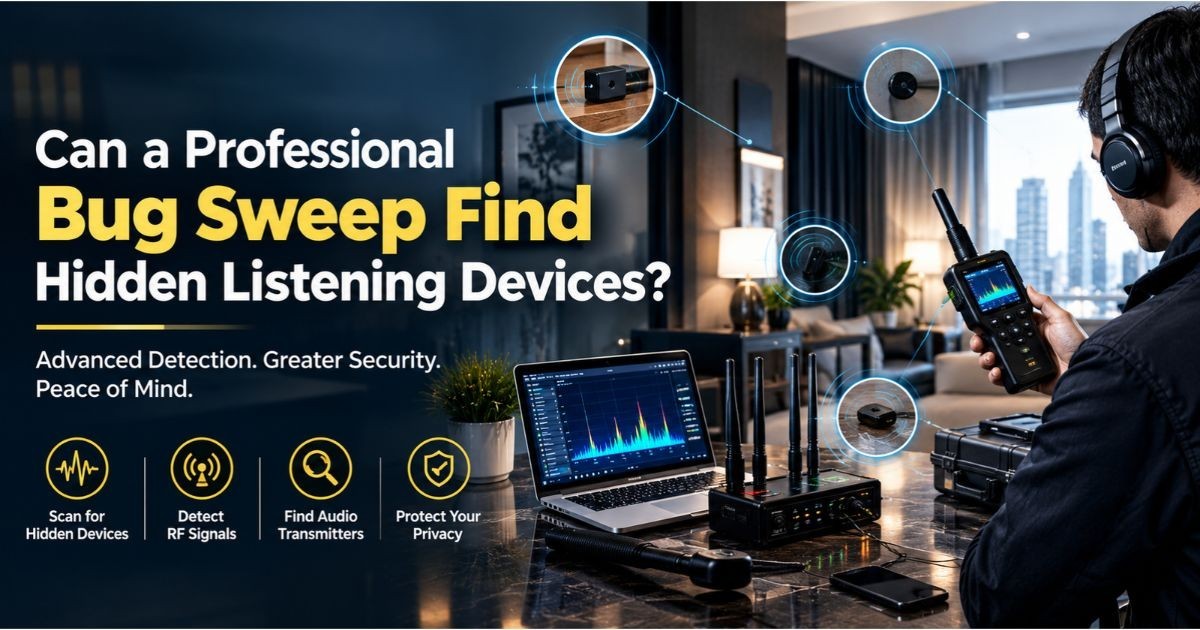
Can a professional bug sweep find hidden listening devices? TSCM combines physical inspection and technical detection to identify potential audio surveillance.

The idea of a hidden listening device may sound like something from a spy movie, but concerns about unauthorized audio surveillance can arise in very ordinary places—such as an office meeting room, executive cabin, residence, hotel room, or vehicle.
The more important question is not simply whether a listening device can be hidden. It is whether a professional inspection can identify one if it present.
In many situations, professional bug sweeping services in Mumbai can help detect hidden microphones, audio transmitters, and other electronic surveillance equipment that they may conceal. However, a sweep's effectiveness depends on the device type, its operation, its concealment, and the detection methods used.
That is why professional audio surveillance detection is considerably more involved than simply walking around a room with a handheld bug detector.
What Are Hidden Listening Devices?
A hidden listening device is a piece of equipment designed to capture conversations or audio without being easily noticed by people in the environment.
Depending on its design, a device may:
· Transmit audio wirelessly
· Record conversations internally for laterretrieval
· Use cellular or other communication networks
· Be connected to a power source
· Operate intermittently
· Remain inactive until triggered
· Be concealed within an everyday object
This variety matters because no single detection technique is suitable for every type of device.
For example, a transmitting device may produce detectable radio-frequency activity, while a standalone recorder that stores audio internally may nottransmit anything during the inspection.
Can a Professional Bug Sweep Detect a Hidden Microphone?
Yes, in many circumstances—but the answer depends on how the devices work.
A professional Bug Sweep Mumbai assessment may use several inspection methods instead of relying on a single detector. The Mumbai TSCM serviceinformation published by Spy Detective Agency describes physical inspection alongside RF, TSCM, and thermal-imaging sweeps for concerns involving audiobugs, hidden cameras, GPS trackers, and other surveillance equipment.
The reason for using multiple techniques is straightforward: different surveillance devices leave different technical or physical indicators.
A professional assessment may therefore examine both the electronic and physical environments.
1. RF Analysis Can Identify Active Wireless Transmitters
Some listening devices transmit captured audio through radio frequencies.
When such a device is actively transmitting, RF analcan provide useful information about unusual activity inithin the inspected environment.
Professional RF analysis can examine characteristics such as:
· Frequency
· Signal strength
· Transmission patterns
· Location or direction of the signal
· Whether the signal corresponds to knownequipment
· Changes in the RF environment during the assessment
However, an important point is often overlooked:
Detecting an RF signal does not automatically mean that a listening device has been found.
Modern offices and homes can contain Wi-Fi routers, Bluetooth equipment, mobile devices, wireless peripherals, smart appliances, cellular signals, andother legitimate RF sources. A professional has to interpret the signal withinthe context of the location.
The goal is therefore not simply to find a signal but to investigate whether an unusual signal warrants further examination.
2. Physical Inspection Can Be Just as Important
Not every listening device announces itself electronically.
A small recording device may be designed to capture audio and store itinternally rather than transmitting continuously. In such a situation, an RF detector may have very little to detect.
This is why a professional assessment for detecting listening devices can include a detailed physical inspection.
Depending on the location and scope, we may pay attention to:
· Electrical fixtures
· Power adapters
· Furniture
· Lighting fixtures
· Meeting-room equipment
· Ceiling and wall areas
· Communication equipment
· Unfamiliar electronic components
· Recently modified objects
· Other locations offering a suitable position foraudio capture
Physical inspection is not about treating every unusual object as suspicious. The objective is to identify genuine anomalies that require technical examination.
3. What About Devices That Are Switched Off?
This is one of the most common questions about TSCM.
If a device is completely powered down and produces no detectable transmission, an ordinary RF sweep might fail to identify it.
However, professional debugging methodologies can also incorporate additional techniques that are specifically designed to identify concealed electronic components. Non-linear junctiondetection (NLJD), for example, is designed to locate semiconductor-based electronics even when the device is not actively transmitting. The precise applicability of these techniques depends on the specific device, materials, environment, and equipment used.
This illustrates why a professional sweep should not be reduced to the phrase “RF scanning.”
RF analysis is one part of a broader technical assessment.
4. Thermal Imaging May Provide Additional Information
Electronic components can generate heat while operating.
Thermal imaging may therefore provide another source of information during certain TSCM inspections, particularly when an active electronic component produces a temperature difference that can be distinguished from its surroundings.
However, thermal imaging also has limitations. Temperature differences can have many ordinary causes, and not every electronic device produces a distinctive thermal signature.
Consequently, thermal findings must be interpreted in conjunction with physical and electronic observations, rather than being considered proof of surveillance on their own.
Why Cheap Bug Detectors Can Create Confusion
Consumer bug detectors can be useful for basic awareness, but they should not be confused with a professional TSCM assessment.
A simple RF detector may alert whenever it encounters radio-frequency energy. In an urban environment such as Mumbai, this can include completely illegitimate signals from mobile networks, Wi-Fi, Bluetooth devices, and other wireless equipment.
At the same time, a device that records audio locally may produce no RFtransmission at the time of the scan.
This creates two potential problems:
False positives:
A normal wireless signal may be mistaken for surveillance equipment.
False negatives:
A non-transmitting recording device may remain undetected by an RF-only approach.
Professional TSCM therefore focuses on method selection and interpretation, not merely detector sensitivity.
Why the Environment Matters in a Mumbai TSCM Assessment
Mumbai presents a particularly active electronic environment.
Offices, commercial buildings, residential complexes, hotels, vehicles, mobile networks, Wi-Fi systems, Bluetooth devices, and other wirelesstechnologies can operate close together.
This makes technical interpretation especially important.
A signal that appears unusual at first may turn out to originate fromlegitimate equipment nearby. Conversely, an unfamiliar device may require physical examination even when there is no obvious RF transmission.
For this reason, a professional Bug Sweep Mumbai assessment shouldconsider the characteristics of the specific location rather than applying the same assumptions to every site.
Where Can Listening Device Detection Be Relevant?
Professional TSCM assessments may be considered for a range of environments, depending on the circumstances.
Corporate Offices
Boardrooms, executive cabins, conference rooms, and other areas wherecommercially sensitive discussions take place may warrant assessment when thereare specific surveillance concerns.
Residential Properties
Individuals may seek an assessment when they have reasonable concerns about unauthorized monitoring within a home or private space.
Hotel Rooms and Temporary Locations
Temporary accommodation can present a different challenge because the occupant may have limited knowledge of who has previously accessed or modifiedthe space.
Vehicles
Vehicles used for executive travel or sensitive conversations may also beassessed for potential audio surveillance or tracking devices.
Meeting & Conference Spaces
A temporary meeting location can be particularly important when sensitive business, legal, financial, or strategic matters are being discussed.
What Happens During a Professional TSCM Assessment?
The exact process depends on the site and the client's concerns, but a structured assessment can involve several stages.
Step 1: Understanding the Concern
The assessment should begin with the circumstances that prompted the request.
Is there concern about a particular room? An unusual object? Information leakage? A suspected microphone? A vehicle tracker?
Understanding the concern helps determine where attention should be focused.
Step 2: Physical Examination
The environment can then be examined for unusual modifications, concealedelectronics, wiring, components, or objects that warrant closer attention.
Step 3: Electronic Analysis
Depending on the circumstances, RF analysis and other specialist detectiontechniques may be used to examine the electronic environment.
Step 4: Technical Correlation
Individual findings should be considered together.
An RF signal, physical anomaly, or thermal difference should notautomatically be labelled as surveillance equipment. Professional interpretation considers the surrounding environment and available evidence.
Step 5: Documentation
Relevant observations can be documented so the client has a clearer understanding of what was examined and what was found.
This distinction between observation and conclusion is important. A professional report should avoid presenting an unexplained anomaly as a confirmed listening device without adequate basis.
Can a Professional Sweep Guarantee That No Listening Device Exists?
No responsible TSCM provider should make an absolute guarantee.
A sweep is an assessment of a particular environment using particularmethods at a particular point in time.
A device may be difficult to detect because it is:
· Not transmitting
· Well concealed
· Powered intermittently
· Connected to existing infrastructure
· Located outside the immediate inspection area
· Designed to minimize detectable signatures
This does not make professional TSCM ineffective. It simply means thattechnical detection has to be described accurately.
The objective is to identify relevant indicators using appropriateinspection methods and interpret the findings professionally, rather thanpromise an impossible level of certainty.
When Should You Consider Audio Surveillance Detection?
A professional assessment may be worth discussing when there is a specific, reasonable concern such as
· Sensitive information appearing outside a restricted group
· Unexplained knowledge of private conversations
· An unfamiliar electronic device in a sensitive area
· Unexpected modifications to an office or meetingroom
· Concerns about a vehicle being monitored
· A new office or premises with an unknown history
· Repeated concerns involving a sensitive meetingenvironment
Importantly, none of these circumstances proves that surveillance is takingplace.
They simply provide a reason to evaluate whether a technical assessment isappropriate.
Choosing Professional TSCM Services in Mumbai
Before engaging a provider, consider whether they can explain:
· What detection methods will be used
· Whether physical inspection is included
· How RF findings will be interpreted
· What equipment is appropriate for the environment?
· Whether the assessment covers the entire requested area
· How findings will be documented
· What limitations apply to the inspection
A professional conversation before the sweep can be just as important as the equipment used during it.
The Bottom Line
So, can a professional bug sweep find hidden listening devices?
In many cases, yes. But the answer depends on the technology involved and the detection methodology used.
Active wireless microphones may leave RF signatures. Concealed electronics may require physical examination or specialist electronic-component detection. Other situations may call for thermal, optical, infrastructure, or additional technical checks.
That is why professional TSCM services should be viewed as a structured assessment rather than simply a search with a handheld detector.
For offices, residences, meeting spaces, hotels, and vehicles in Mumbai, the most effective approach is to begin with the specific concern, choose appropriate detection methods for a spy detective agency, interpret findings in the context of the environment, and clearly distinguish verified observations from assumptions.
Have a Specific Surveillance Concern in Mumbai?
If an office, residence, or meeting space raises legitimate surveillance concerns, call +91 9999335950 for professional bug-sweeping guidance in Mumbai.
The team can discuss the circumstances at your location and help determine whether a TSCM assessment, audio surveillance detection, or another form of technical inspection is appropriate.











Facebook Conversations