
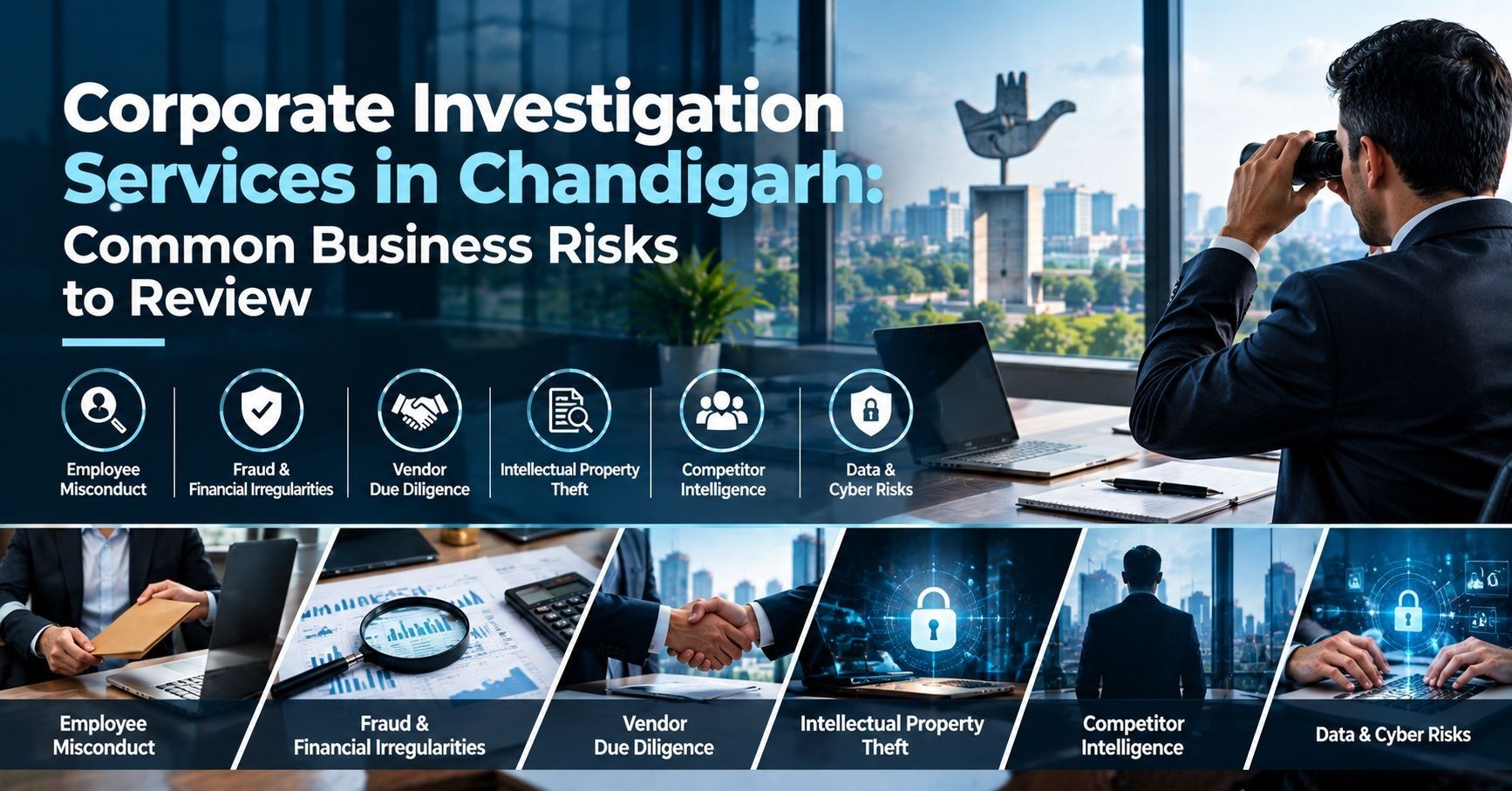
Corporate Investigation Services in Chandigarh: Common Business Risks to Review
Explore corporate investigation services in Chandigarh for business fraud concerns, employee misconduct, vendor verification, and due diligence. Learn how structured, lawful fact-finding can support informed business decisions.

Businesses operate in an environment where reliable information, responsible decision-making, and clear internal processes are essential for success. Unresolved issues, ranging from concerns about employee misconduct to questions about vendor credentials, suspected fraud, or conflicts of interest, can affect business relationships, operational continuity, and financial planning.
In these circumstances, corporate investigation services in Chandigarh may help organisations examine specific concerns through structured fact-finding. A clearly defined investigation can help businesses review available information, identify inconsistencies, and document relevant findings before deciding on appropriate next steps.
Corporate investigations do not assume wrongdoing or treat suspicion as proof. The purpose of corporate investigations is to establish relevant facts through proportionate, lawful methods while respecting the privacy, confidentiality, and rights of the people involved.
What Are Corporate Investigation Services?
Corporate investigations involve examining specific business-related concerns that require independent verification or a more structured review. Depending on the circumstances, an assignment may involve reviewing supplieddocuments, verifying relevant credentials, examining business relationships, conducting appropriate enquiries, or documenting observations connected to a defined concern.
Businesses may consider business investigation services when internalchecks have not adequately clarified an issue or when independent fact-finding could support a more informed decision.
The scope of an investigation depends on the nature of the concern, the information available, and the methods permitted by applicable law. A professional investigator should explain what can reasonably be examined, what limitations may apply, and how the findings will be presented.
Common Business Risks That May Require Investigation
1. Suspected Corporate Fraud and Financial Irregularities
Suspected fraud can create serious operational and financial concerns for an organisation. Unexplained transactions, inconsistent documentation, irregular expense claims, and discrepancies in business records may warrant further review.
A corporate fraud investigation may help examine specific inconsistencies, assess relevant documentation, and establish a clearer record of the available facts. Depending on the assignment, the investigation could involvereviewing authorised records, verifying information, or documenting relevant observations for further assessment.
However, an irregularity does not automatically establish fraud. Differences in records can arise from administrative errors, incomplete documentation, or other explanations. Findings should therefore be assessed carefully, and allegations should not be treated as confirmed without sufficient supporting evidence.
Where a matter involves suspected financial crime, businesses may also needguidance from qualified legal, accounting, or forensic professionals.
2. Employee Misconduct and Workplace Concerns
Workplace concerns can arise from alleged policy violations, conflicts ofinterest, unauthorised disclosure of business information, or conduct that mayaffect an organization's operations.
An employee misconduct investigation may help establish the sequence of relevant events and assess available information objectively. Depending onthe circumstances, the investigation may include reviewing authorized workplace records, examining relevant documentation, or conducting appropriate interviews and inquiries.
A fair process is particularly important when an employee's professional reputation or employment is at stake. Investigators should distinguish allegations from verified facts, avoid conclusions based on rumors, and respect applicable employment and privacy requirements.
Employers should also coordinate with their HR and legal teams when an investigation may lead to disciplinary action or other significant employment decisions.
3. Vendor and Supplier Verification
Businesses often rely on third-party suppliers, contractors, distributors, and service providers. Inaccurate credentials, inconsistent business information, undisclosed relationships, or questionable documentation can create commercial and operational risks.
In Chandigarh, due diligence may help businesses assess relevant information before entering a new relationship or when an existing supplier raises specific concerns.
Depending on the agreed scope, verification may include:
· Checking relevant business registration details through appropriate sources.
· Reviewing supplied credentials and supportingdocuments.
· Confirming relevant business information with authorized sources.
· Examining inconsistencies in vendor-provided information.
· Documenting material findings and any unresolvedquestions.
Due diligence should be proportionate to the business relationship and the level of risk involved. It cannot guarantee that a supplier will perform as expected, but it can help decision-makers evaluate available information moresystematically.
4. Conflicts of Interest and Undisclosed Business Relationships
Conflicts of interest may arise when personal interests, outside business activities, or undisclosed relationships influence professional decisions. These situations can affect procurement, vendor selection, partnerships, and internal governance.
An investigation may help clarify a defined concern by examining relevantrecords, reviewing available disclosures, and verifying information throughlawful channels.
The existence of a personal or professional relationship does notautomatically indicate misconduct. The important questions are whether the relationship is relevant to the business decision, whether required disclosures were made, and whether organizational policies or contractual obligations mayhave been breached.
Clear documentation and a fair review process can help businesses address concerns without relying on assumptions.
5. Unauthorized Disclosure of Confidential Business Information
Business information may include internal documents, client records, commercial proposals, pricing details, product plans, and other non-public material. Unauthorized disclosure can create commercial, contractual, andreputational consequences.
When a suspected disclosure requires investigation, businesses may need toestablish what information was involved, when the issue may have occurred, andwhich authorised records can help clarify the circumstances.
A suitably scoped inquiry may support the review of relevant documentation, authorized access records, or other lawfully available information. Digital evidence may require specialist handling to preserve its integrity and maintain an appropriate record of how it was obtained.
Businesses should avoid attempting to access private accounts or personal devices without lawful authority. Where technical analysis is required, it may be appropriate to involve qualified digital-forensics professionals and legal advisers.
6. Asset-Related Concerns and Unexplained Discrepancies
Organisations may occasionally need to examine concerns involving companyequipment, inventory, business assets, or discrepancies between recorded andreported holdings.
An investigation can help clarify the specific questions involved, reviewrelevant business documentation, and verify available information throughpermissible methods. The assignment may focus on discrepancies, documentedtransfers, authorised records, or other evidence relevant to the matter.
It is important to establish the scope before work begins. Investigators should not promise access to restricted financial information, private records, or assets that cannot lawfully be traced or verified.
Where the matter involves ownership disputes, recovery proceedings, orpossible criminal conduct, the findings may need to be reviewed alongsideprofessional legal advice.
7. Concerns About Business Partners or Prospective Associates
Partnerships and major commercial agreements often involve financialcommitments, shared responsibilities, and access to sensitive information. Before entering into a relationship, a business may want to verify selectedclaims or clarify inconsistencies in information provided by a prospective associate.
A structured review may examine relevant professional credentials, business history, publicly available corporate information, and other details that can be lawfully verified.
For existing relationships, an investigation may also help assess a clearly defined concern involving contractual obligations, business representations, orundisclosed interests.
The objective is to support informed commercial decisions—not to makeunsupported judgments about an individual's character or intentions.
When Should a Business Consider a Corporate Investigation?
Not every operational issue requires an external investigator. In many cases, internal audits, management reviews, HR procedures, or direct communication may be sufficient.
Professional investigative support may be worth considering when:
· A material discrepancy remains unexplained afterroutine internal checks.
· Specific vendor or partner information requiresindependent verification.
· A workplace concern involves conflictingaccounts or relevant evidence that needs structured review.
· An alleged unauthorized disclosure requires further fact-finding.
· A suspected business irregularity needsdocumented examination.
· Management requires an objective record beforedeciding on further action.
The key consideration is whether the concern is specific, legitimate, andsuitable for investigation. A defined objective helps establish realisticexpectations and prevents the process from becoming an open-ended search forpersonal information.
How Does a Corporate Investigation Typically Work?
Although procedures vary according to the assignment, a structured investigation generally follows several stages.
Step 1: Define the Concern
The business explains the issue, provides relevant background, and identifies the questions that need clarification. The investigator assesses whether the requested work is appropriate and identifies any immediate limitations.
Step 2: Agree on the Scope
The parties clarify the proposed activities, expected deliverables, estimated timeline, fees, and communication arrangements. The scope should specify what is included and identify any activities that require separate approval.
Step 3: Review Available Information
Relevant documents and information supplied by the client may be examined toidentify inconsistencies, establish a timeline, and determine which questionsremain unresolved.
Step 4: Conduct Appropriate Enquiries
Depending on the assignment, further inquiries or verification may becarried out through lawful and proportionate methods. Investigators avoid unauthorized access, intrusive practices that lack a lawful basis, and methods that exceed the agreed scope.
Step 5: Document the Findings
A report should distinguish verified information, observations, client-provided claims, and matters that could not be confirmed. It should also explain relevant limitations and avoid presenting uncertain findings as conclusive.
Step 6: Evaluate the Next Steps
Management can review the report alongside internal policies and, wherenecessary, advice from legal, HR, accounting, or technical specialists. An investigation can inform a decision, but it does not replace the organization's responsibility to assess the evidence fairly.
How to Choose Corporate Investigation Services in Chandigarh
Selecting an investigation provider requires more than simply comparing promotional claims. Businesses should assess the proposed approach, professional conduct, and ability to explain the assignment clearly.
Review Relevant Experience
Ask whether the provider has experience with the type of business concern involved. Vendor verification, suspected fraud, employee misconduct, and asset-related inquiries may require different approaches.
Confirm Lawful Methods
Understand how the proposed information will be obtained. Avoid providers who promise unauthorized call records, private account access, restricted databases, or guaranteed evidence.
Request Transparent Pricing
The quotation should explain the scope of work, included activities, estimated duration, possible additional expenses, and payment terms.
Understand Confidentiality Arrangements
Ask how business documents, personal information, findings, and reports will be handled. Confirm who may receive the report and how sensitive information will be communicated and retained.
Ask About Reporting Standards
A useful report should explain the work undertaken, identify the sources or categories of information reviewed where appropriate, and distinguish supported findings from unresolved questions.
Set Realistic Expectations
Investigation outcomes depend on the available information, the circumstances of the case, and legal restrictions. No provider can responsibly guarantee that every allegation will be substantiated or that every question will receive a definitive answer.
Why Lawful and Evidence-Based Investigation Matters
Corporate investigations can affect employment decisions, commercial relationships, and how an organization responds to suspected wrongdoing. For this reason, the process must be fair, proportionate, and based on relevant information.
Responsible investigative practices include respecting privacy, using authorized information sources, maintaining appropriate records, and clearly communicating limitations. Allegations should be evaluated objectively, and individuals should not be considered responsible for misconduct solely because a concern has been raised.
Businesses should also consider whether the matter requires a specialist. Financial irregularities may call for an accountant or forensic auditor, potential criminal conduct may require legal advice or reporting to the appropriate authorities, and technical evidence may require a qualified digital-forensics professional.
The purpose of an investigation is to clarify the facts within its defined scope, not to replace formal legal processes or guarantee a particular outcome.
How Spy Detective Agency Can Assist Businesses in Chandigarh
When a business concern remains unresolved, a structured discussion can help determine whether independent fact-finding is appropriate. Spy Detective Agency provides investigation-related services tailored to specific personal and business requirements, depending on the nature of the assignment and applicable legal boundaries.
Organisations considering corporate investigation services in Chandigarh can discuss the issue, the available documentation, the desired scope, and the reporting requirements before deciding how to proceed. Establishing these details in advance helps clarify expectations regarding methods, costs, timelines, and confidentiality.
Whether the concern involves background verification, a business relationship, suspected misconduct, or another specific issue, the priority should be to take an objective approach that distinguishes verified information from assumptions.
Conclusion
Business risks are not always immediately visible. Unexplained discrepancies, concerns about employee conduct, vendor inconsistencies, suspected fraud, and possible information disclosures may require a closer examination when routine checks are insufficient.
Professional business investigation services can help organizations review defined concerns, verify relevant information, and document findings through lawful and proportionate methods. The value of the process depends on a clear scope, responsible information handling, realistic expectations, and carefulinterpretation of the results.













Facebook Conversations