
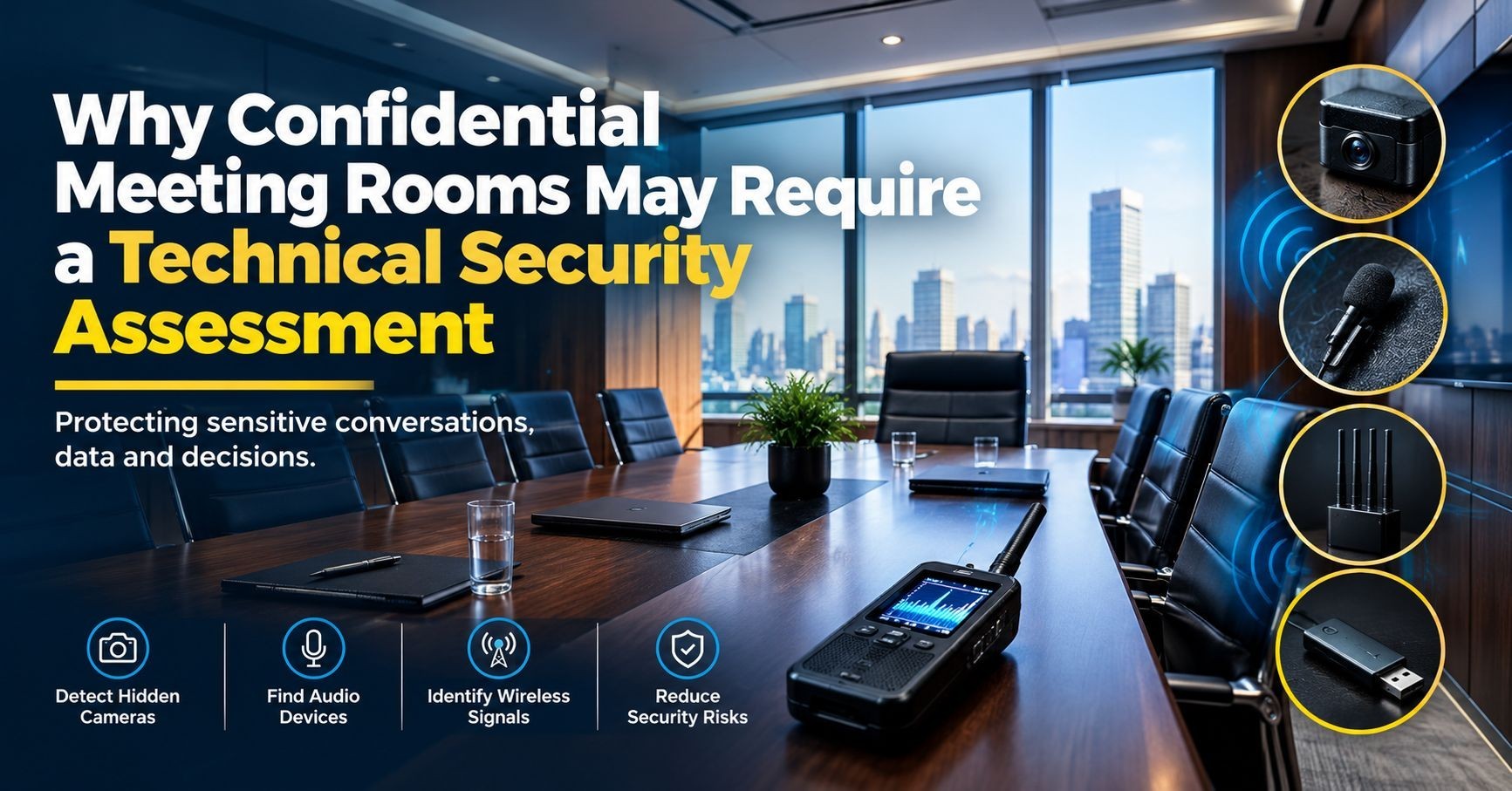
Why Confidential Meeting Rooms May Require a Technical Security Assessment
Discover how TSCM inspections can help businesses assess electronic surveillance risks in confidential meeting rooms, boardrooms, and executive offices in Gurgaon.

Why Confidential Meeting Rooms Deserve Attention
Sensitive business discussions can involve information that has commercial, financial, operational, or reputational significance. Unauthorized disclosure could potentially affect negotiations, competitive positioning, internal decision-making, and relationships with business partners.
Common examples of sensitive discussions include:
- Board meetings involving strategic direction and corporate governance.
- Merger, acquisition, and investment negotiations.
- Financial planning, budgets, and confidential forecasts.
- Discussions concerning new products, intellectual property, and research.
- Executive meetings involving personnel decisions or internal investigations.
- Meetings with external advisers, investors, contractors, or business partners.
Not every confidential meeting requires a specialist technical inspection. However, organisations may wish to review theirarrangements when credible concerns arise, a meeting environment changes, or a specific incident highlights a possible weakness in existing procedures.
What Is a Technical Security Assessment of a Meeting Room?
A technical security assessment examines relevant aspects of a physical environment to identify potential weaknesses and evaluate specificrisks. When concerns involve unauthorized electronic monitoring, a technical surveillance countermeasure inspection may form part of that assessment.
Professional bug sweep inspections may include a combination of physical examination and appropriate technical methods to assess potential indicators of unauthorized electronic surveillance. Depending on the agreed scope, the inspection may include examining relevant room fixtures, electronic equipment, communication devices, and radio-frequency activity.
A professional assessment should be based on the environment, the concern being investigated, and the methods appropriate to the assignment. Any unusual signal or observation needs to be interpreted incontext because legitimate wireless devices and ordinary electronic equipment can also produce detectable signals.
Importantly, a TSCM inspection does not guarantee that every possible surveillance device will be discovered. Its value lies in a structured, technically informed assessment with clearly defined scope, findings, and limitations.
Warning Signs That May Justify a Meeting Room Inspection
There is no single sign that definitively proves a meeting room is being monitored. Nevertheless, certain circumstances may warrant a closer review of the environment.
1. Credible concerns about unauthorized access
If a sensitive meeting room has experienced unexplained access, unauthorized equipment changes, or concerns about the handling offixtures and devices, the organization may consider reviewing access records and the physical environment.
2. Unusual changes to meeting-room equipment
Unexpected changes to conferencing systems, chargers, adapters, cables, or other equipment may warrant verification. Such changes donot establish that surveillance is occurring, but they can provide a practical reason to check equipment ownership, authorization, and configuration.
3. Changes to the physical environment
Office renovations, maintenance work, furniturereplacements, and installation of new electronic systems can change the room's technical environment. Organisations may use these occasions to review access procedures, equipment inventories, and any specific inspection requirements.
4. Sensitive negotiations or high-impact decisions
Some organisations choose to review meeting-room risks before particularly sensitive discussions, especially when the potential consequences of information disclosure are significant. The decision should be proportionate to both the sensitivity of the information and the circumstances involved.
5. A specific information-security incident
If an organization has credible reasons to believeconfidential information has been disclosed without authorization, it consider the full range of possible causes. These may include inappropriate access, compromised accounts, accidental sharing, insecure communications, orphysical surveillance concerns. A technical inspection may be appropriate where the evidence or circumstances point to a physical monitoring risk.
What Does a Professional TSCM Inspection Cover?
The precise scope of the inspection varies based on the room, the reported concern, and the inspection objectives. A professional assessment may include several complementary activities.
Physical examination: Relevant areas, fixtures, andequipment may be examined for unusual modifications or other indicatorsrequiring further investigation.
Technical assessment: Appropriate equipment may beused to examine relevant electronic and radio-frequency activity within the agreed scope.
Equipment review: Meeting-room electronics and other authorized devices may be considered to help distinguish expected activity fromobservations that warrant further examination.
Findings and recommendations: The client shouldreceive an explanation of relevant observations, the limitations of the assessment, and any recommended next steps.
The objective is not to treat every unfamiliar device orelectronic signal as suspicious. Rather, it is to evaluate the availableevidence systematically and communicate the findings in a useful, proportionate manner.
TSCM Inspections Should Complement Existing Security Controls
A technical inspection is only one part of a broader meeting-room security program. Organisations should also consider the following measures.
Access control and visitor management
Limit access to sensitive meeting areas according to business requirements. Maintain appropriate visitor records, establish clear escort procedures where necessary, and review access permissions when responsibilities change.
Meeting-room equipment management
Maintain an inventory of approved conferencing equipment andother electronic devices. Record installations, replacements, and maintenance activities so that unfamiliar equipment can be checked against authorisedrecords.
Confidentiality and meeting procedures
Establish expectations for handling sensitive documents, recording meetings, using personal devices, and sharing information withexternal participants. Apply procedures consistently and communicate thembefore important discussions.
Digital and network security
Use appropriate network controls, account protection, software updates, and access restrictions for connected meeting-room systems. A physical TSCM inspection does not replace cybersecurity testing or the investigation of compromised accounts and digital communications.
Risk-based technical inspections
Consider a professional TSCM assessment when there is a defined concern or when the sensitivity of a particular environment justifiesadditional review. The frequency and scope should reflect the organization's circumstances rather than an arbitrary schedule.
How Businesses Can Prepare for a Meeting Room Assessment
Preparation helps make a technical inspection more focused and productive.
- Define the concern. Identify the room or area involved and explain the circumstances that led to the request.
- Set the inspection scope. Clarify which spaces, equipment, and potential risks should be assessed.
- Review authorized equipment. Prepare available records of installed electronics, recent maintenance, and approved devices.
- Coordinate access. Arrange suitable access to the relevant areas and identify an appropriate point of contact.
- Discuss reporting expectations. Confirm how observations, limitations, and recommendations will be documented.
- Plan follow-up actions. Determine who will review the findings and how any identified concerns will be addressed.
A clearly defined scope allows the inspection to focus onthe organisation's actual concerns and helps set realistic expectations about what the assessment can establish.
Choosing Professional TSCM Services in Gurgaon
When evaluating a provider for a confidential meeting roominspection, businesses should look beyond equipment descriptions alone. Relevant technical experience, a clearly explained methodology, appropriate handling of sensitive information, transparent scope, and documented findings are all important considerations.
It is also useful to ask what the proposed inspection includes, which limitations may apply, and whether any observations wouldrequire additional investigation. A professional provider should communicate these points clearly rather than promise absolute protection or guaranteeddetection.
For organisations seeking boardroom TSCM in Gurgaon, the right approach begins with understanding the potential risk, defining the required assessment, and selecting methods appropriate to the environment.
Frequently Asked Questions
Does every confidential meeting room need a TSCM inspection?
No. The need depends on the sensitivity of the information, the organization's risk assessment, and any specific circumstances that raise concern about unauthorized electronic monitoring.
Can a TSCM inspection guarantee that no listening device is present?
No inspection can guarantee that every possible device will be discovered in every circumstance. The results depend on the scope of the inspection, the methods available, the environment, and the characteristics of the equipment being assessed.
Is TSCM the same as cybersecurity testing?
No. TSCM focuses on potential indicators of technical surveillance in physical environments. Cybersecurity testing focuses on digital systems, networks, applications, and the associated risks. Depending on the concern, both may be relevant.
When should a business consider a boardroom inspection?
A business may consider an inspection when there is a specific surveillance concern, unexplained equipment change, relevant securityincident, or a risk-based reason to review a sensitive meeting environment.
Can TSCM services be arranged in Gurgaon?
Businesses can inquire about professional TSCM and debugging services in Gurgaon to discuss their requirements, the proposed inspection scope, and the suitability of an assessment for their environment.
Conclusion: Make Meeting-Room Security Part of Business Risk Management
Confidential meeting rooms support decisions that can shape an organization's financial position, commercial relationships, and futuredirection. Managing the associated risks requires more than a single security measure. Access controls, equipment management, clear meeting procedures, cybersecurity practices, and targeted technical assessments can work togetheras part of a proportionate approach.
Where there is a defined concern about unauthorized electronic monitoring, a professional TSCM inspection can help assess potentialindicators and provide information for informed next steps.
Review your meeting-room inspection requirements before your next sensitive business discussion. Contact Trace Point India at 9999335950 to inquire about professional TSCM assessments in Gurgaon.












Facebook Conversations